
Introduction
When farmers switch to a new practice, everyone tends to ask the same question: how much does it cost? But that question only tells half the story. A cheaper input might harm the soil for years to come. A slightly pricier practice might protect a soil’s health, keep more people working the land, or leave a river cleaner for the next generation. We believe the real price of any farming solution goes far beyond what’s printed on the invoice.
That’s why we are developing a way to measure the “hidden” costs and benefits of the project’s farming innovations — from organic crop production, cattle production to agroforestry and smart water management. The method that we are using is Full-Cost Accounting, and it’s helping us build a fuller, fairer picture of what these solutions actually mean for people, for land, and for the region’s future.
It’s a question worth asking across the whole Pannonian Basin, where farmers are already dealing with more droughts and unpredictable rainfall patterns. If sustainable practices are ever going to be adopted at scale, they need to make sense not only on a spreadsheet but in real life, for farmers and communities.
Markus Spiske / Unsplash
Why Money Alone Doesn't Tell the Whole Story
Traditional cost calculations look only at what goes from and into a farmer’s pocket: seed prices, equipment, labour, and the market price of the harvest. That’s useful information, but it misses a lot. It doesn’t count the value of healthier soil that keeps producing for decades. It doesn’t count what a community loses when water sources dry up or gains when biodiversity returns to a field. And it rarely counts the toll on people’s health and safety, or the well-being of the workers actually doing the job.
These missing pieces are called externalities — costs or benefits that fall outside the price tag, but still affect people and places, sometimes for a very long time. A field that looks profitable today can become a liability tomorrow, once the soil is exhausted or the water table has dropped too far to recover easily.
Integrating trees with crops for sustainability / https://farmingfarmersfarms.com/2024/03/agroforestry-integrating-trees-with-crops-for-sustainability/#google_vignette
How We're Measuring the Hidden Value
In the ClimaPannonia project we are applying Full-Cost Accounting, a method that adds these hidden layers back into the equation. Alongside this, we use a related tool called Social Life Cycle Assessment, which looks specifically at how a solution affects human rights, labour conditions, health and safety, and the well-being of local communities across the Pannonia Basin.
Together, these tools let us compare, side by side, our climate-smart solutions against the conventional methods farmers use today. We’re not just asking “is it cheaper?” We’re asking, “is it better, for everyone involved, in the long run?”
The socio-economic assessment is directly grounded in data collected from the demonstration sites. It is implemented alongside a parallel environmental assessment based on Life Cycle Assessment, which quantifies impacts such as greenhouse gas emissions, water use, and impact on biodiversity. When combined, these two assessment perspectives provide a comprehensive view of the economic, social, and environmental performance of each solution.
Unsplash
What This Means on the Ground
Picture two farmers in the Pannonian Basin. One keep using an intensive irrigation method that gives a good short-term yield but is slowly depleting the local water table. The other switches to a water-efficient system tested on one of our demo sites. On paper, the second farmer’s upfront costs might look similar, or even slightly higher. But once we add up the long-term value of preserved water resources, more stable yields during dry years, and reduced risk for the whole community, the picture changes completely.
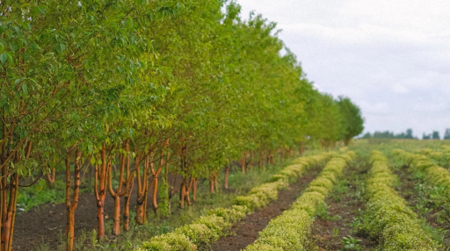
Or take an agroforestry demonstration site, where trees are planted alongside crops. The initial investment and the wait for trees to mature can look discouraging on a simple balance sheet. But factor in the shade that protects crops during heat waves, the extra income from fruit or timber down the line, and the carbon the trees quietly capture year after year, and a very different story emerges.
This is precisely what our assessment aims to make visible— turning something that’s usually invisible, like the cost of environmental degradation or the value of community resilience, into numbers that farmers, businesses and policymakers can actually use in real decisions. It’s not about telling farmers what to do; it’s about giving them a fuller set of facts to decide with.
Why It Matters for the Future
umbers alone don’t change farming practices, but the right numbers, shared with the right people, can shift decisions. By showing the true socio-economic value of climate-smart solutions, we hope to give farmers stronger arguments when weighing their options, give businesses a clearer case for investing in sustainable practices, and give policymakers solid evidence to support the kind of agriculture the Pannonian region will need in a changing climate.
But this isn’t only a question for farmers, businesses, or policymakers. It’s a question for the whole community. Every drop of water saved, every hectare of healthier soil, every job protected on a local farm ripple outward — into food prices at the local market, into the resilience of villages during the next drought, into the landscape that future generations will inherit. When we talk about the “real price” of a farming solution, we’re really talking about the price a whole region pays, or saves, together.
This work also feeds directly into the project’s broader goal of connecting our solutions to the objectives of the Common Agricultural Policy and National Strategic Plans, so that what we learn on the ground can help shape decisions on a much bigger scale. By the end of the project, we aim to bring socio-economic data, environmental results, and policy alignment together into a set of clear, evidence-based recommendations — because the communities of the Pannonian Basin deserve farming solutions that work for them, not just on paper, but in everyday life.
Gabriel Jimenez / Unsplash
None of this happens overnight, and none of it happens in isolation. It takes farmers willing to test new approaches on their own land, researchers willing to sit with the numbers long enough to see the full picture, and communities willing to ask harder questions about what “affordable” and “sustainable” really mean, side by side. If we get this right, the true cost (and the true value) of farming won’t be a hidden calculation buried in a report. It will be something everyone in the region can see, understand, and build on for years to come.
Author: Stefan Karajanković, Institute for Development and Innovation – IRI
