

How Agroforestry Builds Climate Resilience in Hungary
Agriculture in the Pannonian Basin is increasingly impacted by climate extremes such as strong radiation, uneven rainfall distribution, atmospheric droughts, and the lack of an optimal microclimate(Láng et al. 2007 ; Crocetti et al. 2020 ). These shifts pose serious risks to agriculture. Berry production is one of the endangered agricultural sectors facing declining crop yields, crop quality, and crop resilience. ClimaPannonia helps address these challenges through collaborative research, joint field technology development, and transfer of proven good practices with stakeholders. But how can we ensure that the jointly developed methods are truly functional in everyday farming practice? Can this transform and save berry production, which is struggling in the trap of climate change?
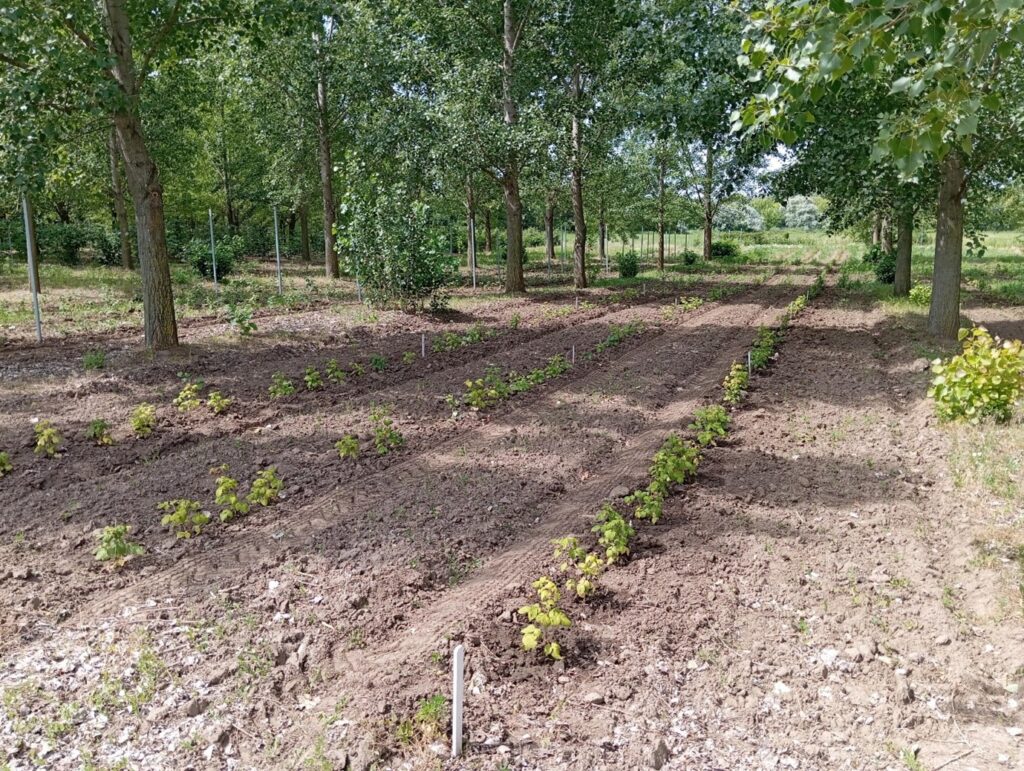
DeepDem agroforestry experiment established at Fertőd, Hungary to validate climate-smart agricultural practice that can transform berry production in the Pannonian Basin (Photo by Jenő Varga)
Core problem
In the Pannonian Basin, climate change is amplifying extreme weather – particularly summer droughts and heat waves – making even irrigated berry production financially and ecologically risky. Raspberry growers face elevated water needs, rising production costs, and limited irrigation availability during prolonged dry periods. Persistent drought plus intense sunlight further stresses crops, reducing yield, quality and profitability, threatening the viability of berry cultivation.
Literature evidence
Model-based projections mark the Pannonian Basin as one of the most drought-sensitive regions in Europe, anticipating deeper and more frequent summer droughts by 2050.(Láng et al. 2007b; , Crocetti et al. 2020)
Quantitative data
Between 1981–2016, the number of reported drought-related impacts in agriculture exceeded 1000 in key Pannonian countries. Furthermore, an average increase of 0.10 – 0.35 °C per decade of annual average air temperature was detected based on data between 1960 and 2017. (Jakubínský et al. 2019; Bueechi et al. 2023 .
Overview
Berry-poplar mixed agroforestry system is one of the systemic nature-based approaches which will be tested and validated in ClimaPannonia project.
Approach
Agroforestry and control (no-tree) systems will be field-tested in donor country (Hungary), then adapted in partner regions (berry agroforestry in Serbia and arable agroforestry in the Czech Republic). To improve the production of berries and their adaptability in the field, ClimaPannonia tests and validates integrated agroforestry systems for berry production in close cooperation with stakeholders.
The infographic visualizes how agroforestry systems act as water-retaining infrastructure by shading, reducing evaporation, enhancing infiltration, and buffering temperature spikes. It illustrates components such as trees, soil layering, and hydrological flows—highlighting nature-based adaptation strategies relevant to ClimaPannonia’s goals.
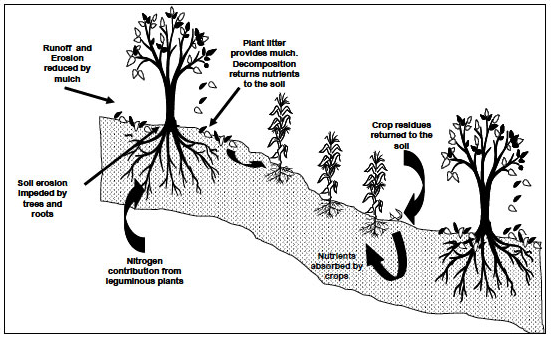
Potential benefits of an agroforestry system on ecosystem functioning (Source: Everson et al. 2011)
Field experiments
In Fertőd (Hungary), agroforestry experiments combining shade trees with raspberry cultivation are led by the University of Sopron and the Hungarian University of Agriculture and Life Sciences while the University of Novi Sad and Mendel University is piloting demonstration plots in Serbia and the Czech Republic for local adaptation and scaling.
Knowledge transfer
The project includes development of training materials and decision‑support system elaborated in Living Labs involving farmers, consultants, researchers, policymakers, and citizen scientists. Workshops and national/regional policy forums will facilitate the uptake.
Pilot results in Fertőd
During previous pilot experiments in Hungary, agroforestry systems have demonstrated practical improvements:
- reduced microclimatic heat stress,
- better soil moisture retention,
- more efficient water management by utilizing groundwater resources that are only accessible through trees,
- mulching effect of forest litter,
- reduced soil erosion rate,
- stabilized yields with enhanced berry quality (e.g. higher sugar and nutrient content),
- additional yield of wood for industry,
- increased biodiversity from habitat heterogeneity,
- and lower carbon footprint per unit output.( Rétfalvi et al. 2021 )
Adaptation insights
Although direct farmer testimonials are not yet published, involvement of major regional research institutions reflects recognition and planned wider replication. Living Labs and policy workshops ensure that real-world feedback informs iterative improvements and regional scalability.
Comparative context
Future Perspectives
- Evolution of solutions:
- Pilot data from Living Labs will inform adaptive decision-support tools that quantify benefits (e.g., yield gain, better water management, biodiversity indices, carbon sequestration).
- Ongoing monitoring enables iterative refinement of tree-crop arrangements, water management, and organic management techniques.
- Stakeholder engagement:
- Farmers provide feedback on usability, cost-benefit, and practical barriers.
- Researchers/universities evaluate agronomic performance and ecological impacts.
- Policymakers and extension services help promote up-scaling via regulations, subsidies, and educational outreach.
- Citizen scientists capture local observations and contribute to broader awareness.
- Scaling across regions:
The project’s multi-country model-adapting proven donor-country agroforestry models to other Pannonian countries-supports broader adoption and policy integration at regional, national, and EU levels.
Climate change is reshaping berry production in the Pannonian Basin – yield losses, heat stress, and limited irrigation threaten economic viability. Agroforestry practices have emerged as promising adaptation strategies. Field trials in Fertőd and permaculture engagements across Hungary reinforce their effectiveness. Serbia’s high production underscores potential capacity if sustainable practices are scaled.

Authors:

Dr. Andrea Vityi
Dr. Andrea Vityi, assoc. prof. , PhD in Environmental Sciences, senior lecturer in agroforestry and environmental sciences at the University of Sopron. She works/worked as lead/senior researcher in projects related to agroforestry, wood plantations, bioenergy, biofuel standardization, and green-education development (HE REFOREST, HE AGROSUS, H2020 AFINET, FP7 AGFORWARD, E+ AGFOSY, FP6 NetBiocof, FP5 BioNorm and several national projects). Currently works in agroforestry-, ecological farming, bioenergy- and LCA-related national and Horizon Europe projects. She is Hungarian delegate of the European Agroforestry Federation, charge d’affaires of the Hungarian Agroforestry Civil Group and member of the Hungarian Agroforestry Network and the Hungarian Permaculture Association. She is a fun of nature, likes hiking and cultivate a garden, where she introduced the practice of organic farming.
Contact: vityi.andrea@uni-sopron.hu

Dr. Zoltán Gribovszki
Dr. Zoltán Gribovszki is a university professor at the University of Sopron, a doctor of the Hungarian Academy of Sciences, a certified forest engineer and a university engineer in hydraulic engineering. His research field is eco-hydrology, more specifically the effect of vegetation on the daily fluctuations of hydrological characteristics and the information that can be recovered from this. He is a member or official of 15 domestic and international organizations, has professional relations with 9 foreign and 7 domestic research institutions. He is the leader of several domestic and international projects.
Contact: gribovszki.zoltan@uni-sopron.hu

Dr. Jenő Varga
Dr. Jenő Varga is a Senior Research Fellow, Head of the Fertőd Research Station of the Institute of Horticulture of the Hungarian University of Agricultural and Life Sciences. His research interests include the ex situ conservation of plant genetic resources, predominantly from berry species, and the technological development of berry production adapted to climatic changes. Member of the Public Body of the Hungarian Academy of Sciences (Plant Breeding Scientific Committee), and the Hungarian Plant Breeders' Association.
Contact: varga.jeno@uni-mate.hu
Literature
Crocetti, Laura & Forkel, Matthias & Fischer, Milan & Jurecka, Frantisek & Grlj, Aleš & Salentinig, Andreas & Trnka, Miroslav & Anderson, Martha & Ng, Wai-Tim & Kokalj, Žiga & Bucur, Andreea & Dorigo, Wouter. (2020). Earth Observation for agricultural drought monitoring in the Pannonian Basin (southeastern Europe): current state and future directions. Regional Environmental Change. 20. 123. 10.1007/s10113-020-01710-w.
Láng I., Csete L., Jolánkai M. (2007a) A globális klímaváltozás: hazai hatások és válaszok (A VAHAVA Jelentés). Agrokémia és Talajtan, 56 (1). pp. 199-202. ISSN 0002-1873
Láng I., Csete L., Jolánkai M. (2007b) A globális klímaváltozás: hazai hatások és válaszok – A VAHAVA jelentés. Szaktudás Kiadó Ház Zrt. p. 220
- Bueechi, M. Fischer, L. Crocetti, M. Trnka, A. Grlj, L. Zappa, W. Dorigo (2023) Crop yield anomaly forecasting in the Pannonian basin using gradient boosting and its performance in years of severe drought, Agricultural and Forest Meteorology, Volume 340. ISSN 0168-1923,
https://doi.org/10.1016/j.agrformet.2023.109596.
Jakubínský, J., Bláhová, M., Bartošová, L., Steinerová, K., Balek, J., Dížková, P., … Trnka, M. (2019). Repository of Drought Event Impacts Across the Danube Catchment Countries Between 1981 and 2016 Using Publicly Available Sources. Acta Universitatis Agriculturae et Silviculturae Mendelianae Brunensis, 67(4), 925-938. doi: 10.11118/actaun201967040925
Rétfalvi T. (szerk) TERMELJÜNK EGYÜTT A TERMÉSZETTEL! – AZ AGRÁRERDÉSZET, MINT ÚJ KITÖRÉSI LEHETŐSÉG.Projektzáró tanulmánykötet. Soproni Egyetem Kiadó Sopron, 2021. ISBN 978-963-334-373-9 (online)
Everson, CS, Dye, PJ, Gush, MB, & Everson, TM. (2011). Water use of grasslands, agroforestry systems and indigenous forests. Water SA, 37(5), 781-788. Retrieved July 29, 2025, from http://www.scielo.org.za/scielo.php?script=sci_arttext&pid=S1816-79502011000500019&lng=en&tlng=en.