Demonstration and Modelling of Nature Based Solutions to Enhance the Resilience of Mediterranean Agro-Silvo-Pastoral Ecosystems and Landscapes
Guest edition: featuring a sister project
DRYAD a Horizon Europe project running from 2024 to 2028, is implementing nature-based solutions (NbS) to enhance climate resilience in Mediterranean agro-silvo-pastoral ecosystems.
By combining cutting-edge scientific innovations, transformative solutions and traditional knowledge, DRYAD tests NbS in five demonstration regions and scales the most effective solutions to three replication regions, supporting sustainable management and adaptive governance across the Mediterranean.
Abstract
Mediterranean agrosilvopastoral ecosystems (MAEs), such as Spain’s Dehesa and Portugal’s Montado, are vital for local communities and economies, but they are threatened by climate change. Droughts, wildfires, and high tree mortality pose severe risks to these landscapes. Addressing these challenges requires local solutions and transformative approaches to build climate resilience. Local communities and authorities need support to adapt effectively. In this context, the EU-funded DRYAD project aims to tackle these issues by developing and implementing climate-resilient, NBS. Focusing on regions such as Andalusia, Alentejo, and Sardinia, DRYAD will test innovative NBS, later transferring successful solutions to additional regions. By engaging local authorities, stakeholders, and citizens through Living Labs, DRYAD seeks to create sustainable, adaptable practices.
Demonstration and replication regions
The project will be centered around development, testing and demonstrating nature-based solutions in 5 Demonstration Regions (DRs) and will be transferred to 3 Replication Regions (RRs)
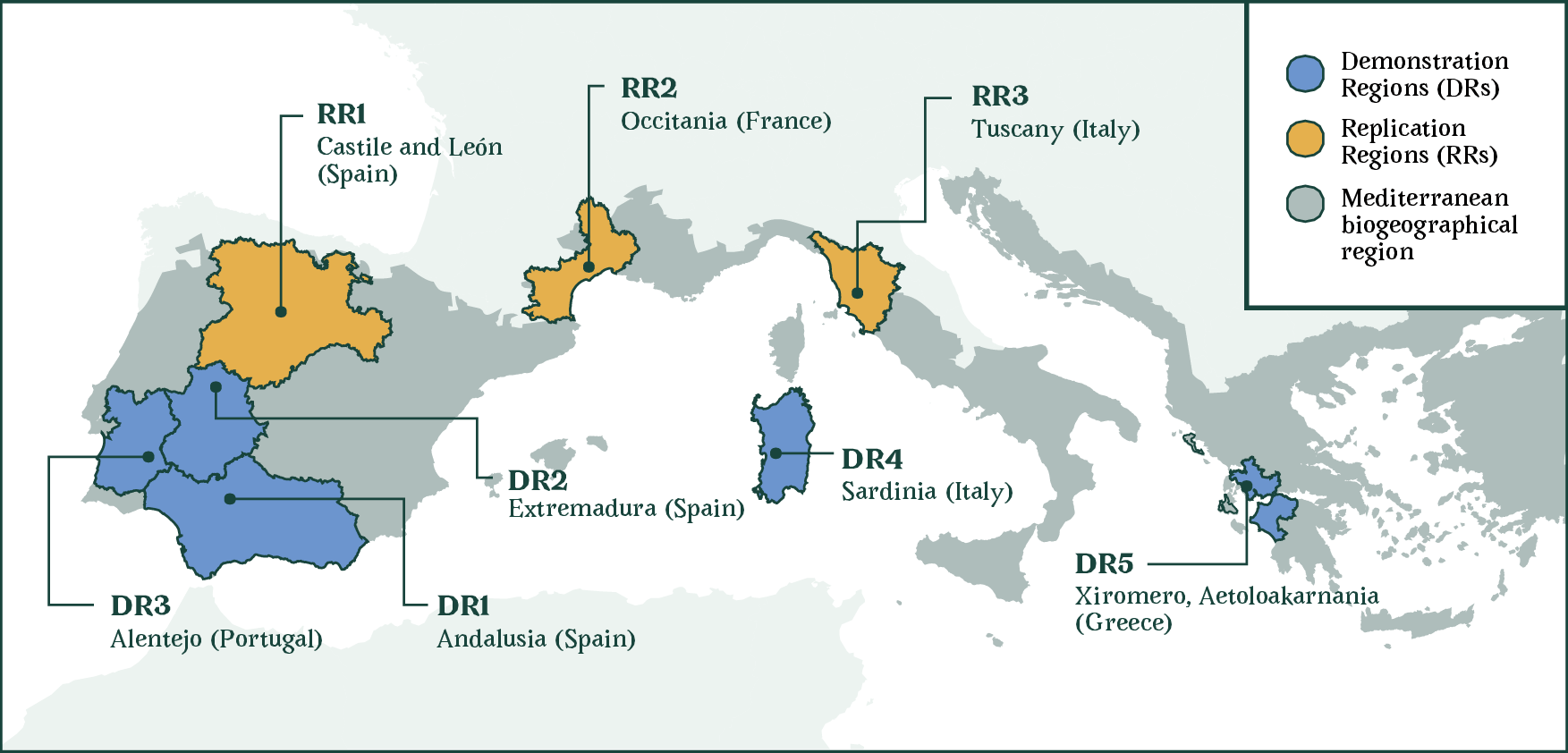
Dryad is coordinated by the University of LA Coruña (UDC). It joined together 27 partners from 6 different countries.